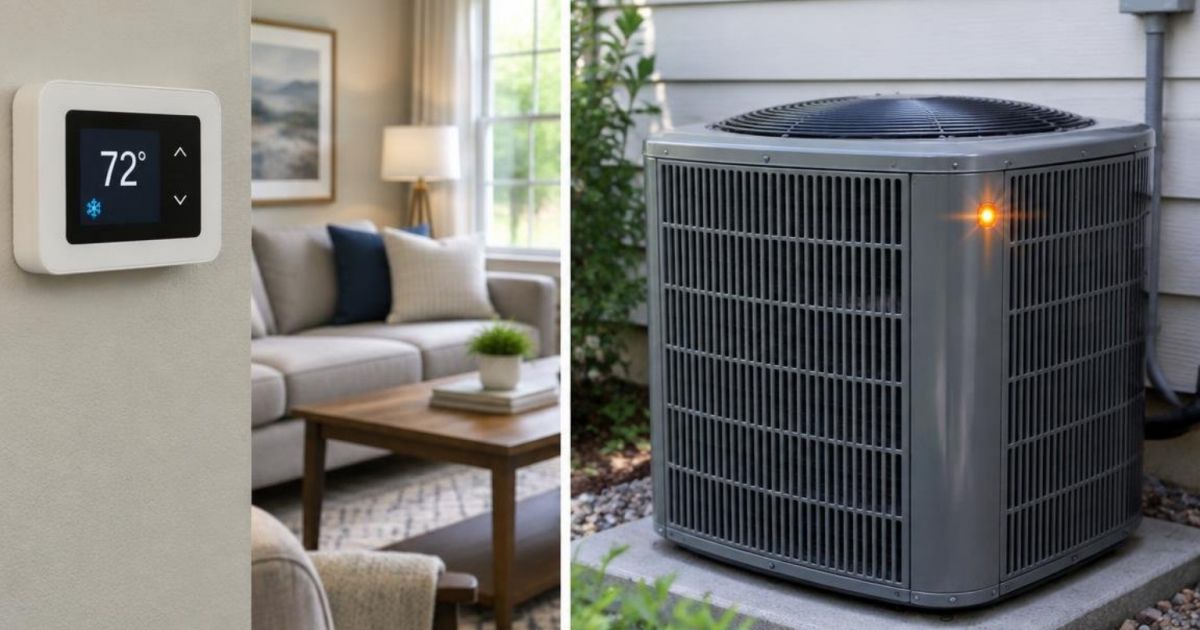
Living in Florida without a working AC is impossible. But have you ever felt “cool but clammy” inside your own house? This happens because most contractors rely on standard national rules that weren’t designed for the humid South.
So, why do standard sizes fail us in the Sunshine State? The wrong size places extra strain on the unit, leading to more frequent calls to cooling and heating services. The simple solution for this hassle? Having the right AC size for your Florida home.
When your AC is sized for Florida, it runs smoothly and efficiently. It doesn’t just lower the temperature; it removes moisture, keeping your indoor air crisp, breezy, and comfortable all year long.
But why is a national standard size not feasible in Florida? Let’s discuss them in detail.
Why Does Standard HVAC Sizing Don’t Work for Florida Homes?
National HVAC standards are designed to work for the average American home. These averages include states such as Ohio, Colorado, and Oregon, where heating is as essential as cooling.
In Florida, we don’t place much emphasis on heating loads. Our HVAC systems work overtime to fight sensible heat (the temperature you see on the thermostat) and latent heat (the moisture in the air). If your contractor follows a generic national chart, your unit might be “right” for the square footage but “wrong” for the Florida swamp.
1. The Humidity Factor
Humidity is the biggest reason Florida homes need unique sizing. In drier states, an AC unit only needs to lower the temperature. In Florida, the AC has two jobs: cooling and dehumidifying.
The Danger of Short-Cycling
If you install an oversized unit based on a rough estimate, it will cool your house very quickly and then shut off. This is called short-cycling. Although the air feels cool, the unit didn’t run long enough to remove moisture from the air.
- The Result: Your home feels “clammy.”
- The Risk: High humidity promotes mold growth and dust mite activity.
Florida HVAC sizing focuses on ensuring the unit runs for longer, steadier cycles. This allows the evaporator coil enough time to remove water from the air like a sponge.
2. Intense Solar Heat Gain
Florida gets more direct, intense sunlight than almost any other state. This “solar gain” hits your roof and pours through your windows.
National standards often underestimate the amount of heat a Florida sun can penetrate a home. A 2,000-square-foot house in Seattle might require a 3-ton unit, but the same house in Orlando, exposed to 10 hours of intense radiation, might need more capacity or specialized ductwork to handle the load.
3. Understanding Sensible vs. Latent Loads
To get sizing right, Florida heating and air conditioning services use a Manual J Load Calculation. This isn’t a guess; it’s a math formula that looks at two specific things:
- Sensible Load: The energy needed to lower the air temperature.
- Latent Load: The energy required to remove moisture.
In most of the U.S., load management is the priority. In Florida, the latent load is often the bigger challenge. A system sized for Florida must be able to handle both effectively without wasting energy.
4. Higher Efficiency Standards (SEER2)
Florida is part of the “South/Southwest” region according to the Department of Energy. Because our AC units run almost year-round, our efficiency requirements are stricter than national minimums.
As of 2023, new installations in Florida must meet a minimum SEER of 14.3 (equivalent to 15 SEER). In colder northern states, the requirements are lower because their units stay off for half the year. Choosing a unit based on a “national minimum” may be illegal or inefficient for a Florida installation.
5. Home Characteristics: Old vs. New
Florida’s housing market is a mix of 1950s concrete block homes and 2020s high-efficiency builds.
- Older Homes: These often have “jalousie” windows or poor attic insulation. They leak cool air and let humidity in. These homes need “beefier” systems to compensate for the loss.
- Newer Homes: These are sealed tight. While they stay cool easily, they can actually trap humidity inside. These homes often need smaller, variable-speed units that can run at low power for hours to keep the air dry.
What Happens if You Get the Sizing Wrong?
If you ignore Florida-specific sizing and “go with your gut” or a national average, you will face a few signs that your AC is energy efficient. Some of them are
Common HVAC Problems & Causes
The Solution: Assistance From Local Cooling and Heating Services
When it’s time to replace your AC, don’t just look at the “tons” or the square footage. You need a system designed for the Florida Climate Zone. Here, you can consult HVAC service and repair experts to analyze your home and help you select the correct size.
Experts will ask you to look for these features:
- Variable-Speed Blowers are well-suited to Florida because they can slow down to extract more moisture from the air.
- Multi-Stage Compressors allow the unit to run at 60% capacity on a mild day and 100% on a scorching July afternoon.
- Dehumidification Modes: Some units have a “dry mode” specifically for our humid, rainy seasons.
Conclusion
Florida homes, especially in Palatka, do not align with the national average. Heat loads run higher. Humidity loads run heavier. Sun exposure lasts longer. When contractors size systems using national formulas, homeowners pay higher bills, experience discomfort, and face frequent service calls.
Well-designed cooling and heating services for Florida focus on moisture removal, long cooling cycles, proper airflow, and accurate load calculations. They size systems for Florida’s reality, not the country’s average. That’s the difference between a sticky home and a comfortable one.
Southern Air Cooling & Heating offers expert HVAC design tailored explicitly to Florida’s climate. For homeowners in Palatka, our professional cooling and heating services help keep your home comfortable and your energy bills in check. So, contact us today!
Request Service
Please fill out the form below to request an estimate or schedule service.
"*" indicates required fields