What to Do When Your AC Is Not Switching On
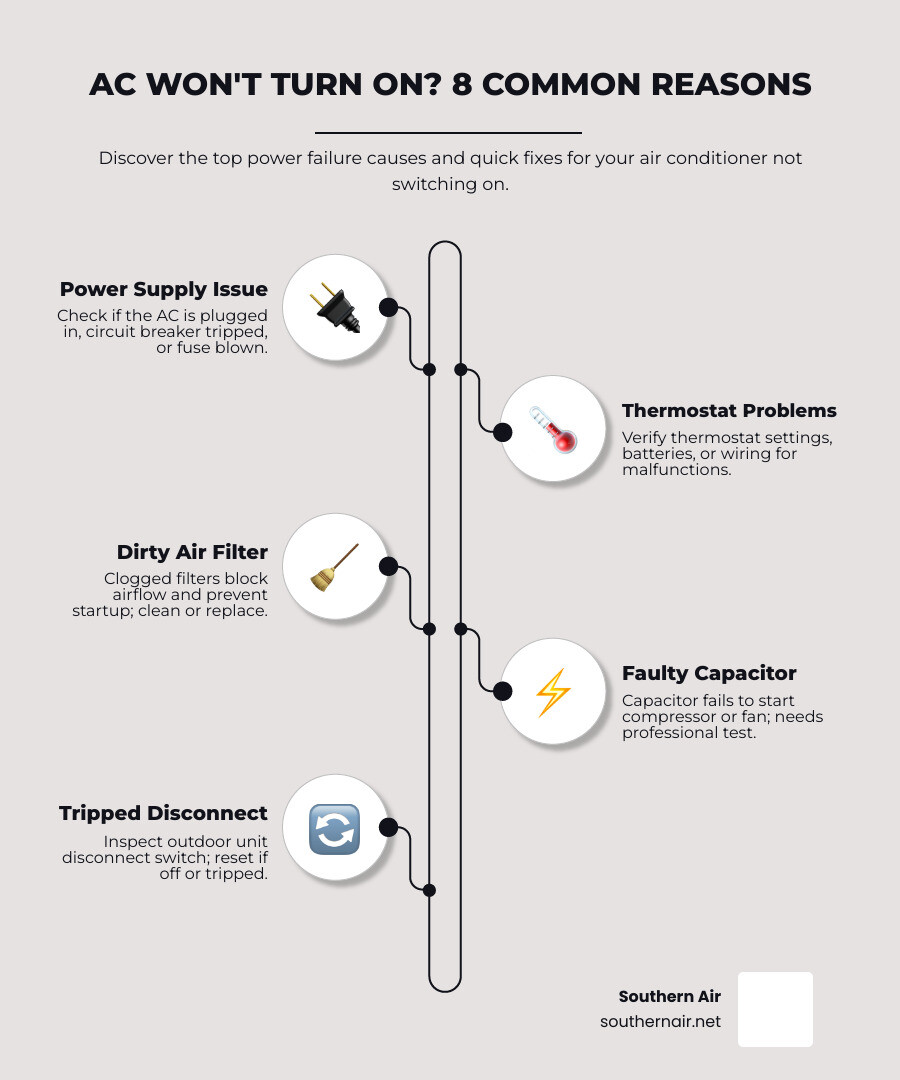
If your AC not switching on is the problem right now, here are the most common causes and first steps:
- Check your thermostat: Make sure it’s set to “Cool” and the temperature is at least 3–5°F below room temperature. Replace the batteries if the screen is blank.
- Reset the circuit breaker: Go to your electrical panel and look for a tripped breaker. Flip it fully off, then back on.
- Check the shutoff switches: There’s usually one near your indoor unit and one at the outdoor disconnect box. Make sure both are on.
- Inspect the air filter: A severely clogged filter can trigger a safety shutdown. Replace it if it looks dirty.
- Look for ice on the unit: Frozen coils will prevent startup. Turn the system off and let it thaw before restarting.
- Check the drain line: A clogged condensate drain can trip a float switch that cuts power to the whole system.
- Press the reset button: Many outdoor units have a reset button. Hold it for 3–5 seconds, then wait 30 minutes before restarting.
- Call a professional: If none of the above work, you likely have a failed capacitor, faulty contactor, refrigerant leak, or wiring issue.
Living in Florida, a broken AC isn’t just uncomfortable, it can become a health issue fast. Whether it’s a simple fix like a tripped breaker or something more serious like a failed capacitor, knowing where to start saves time and money.
In this guide, we’ll walk through all 8 reasons your AC might not be turning on, and exactly what to do about each one.
I’m Dustin Caison, President and CEO of Southern Air Cooling & Heating, a State Certified Air Conditioning Contractor with over two decades of hands-on experience diagnosing AC not switching on issues across North Florida. With that background, I’ll help you figure out whether this is a quick DIY fix or something that needs a professional’s attention.
Immediate Checks When Your AC Is Not Switching On
When you walk into a sweltering house in Palatka or St. Augustine and realize the air isn’t moving, it’s easy to panic. Before you assume the worst (and the most expensive), there are several “low-hanging fruit” checks you should perform. Often, the reason for an AC not switching on is a simple safety feature doing its job or a minor power interruption.
Start with the thermostat. It sounds basic, but you would be surprised how many service calls are resolved by simply switching the mode from “Heat” or “Off” back to “Cool.” If the screen is blank, the batteries may have died, breaking the communication link to your HVAC unit.
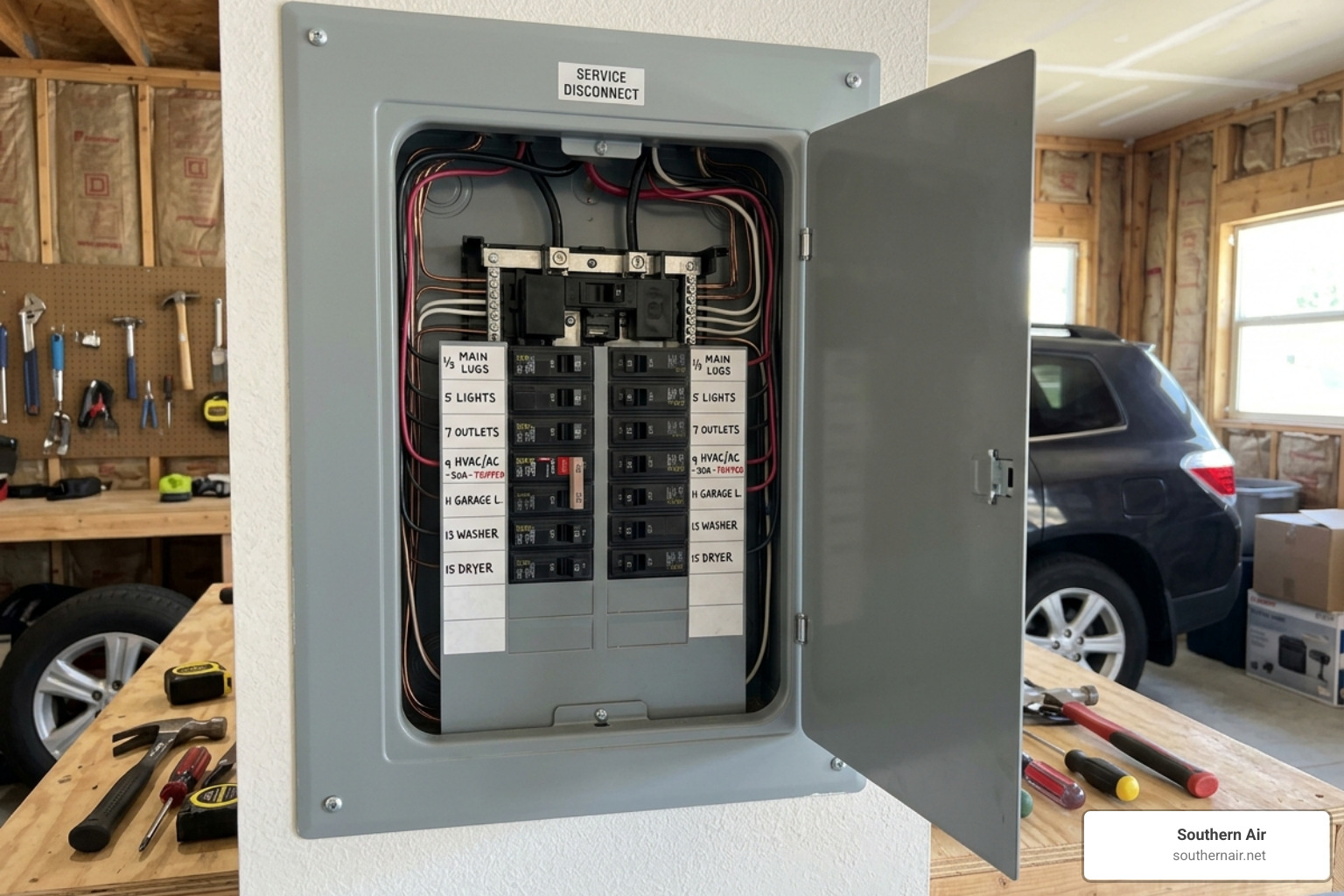
Next, check your home’s electrical heart: the breaker panel. Air conditioners draw a significant amount of power, especially during the initial startup surge. This can occasionally trip a circuit breaker, especially during our intense Florida lightning storms or periods of high grid demand.
Finally, verify the physical switches. Your AC system actually has multiple “on/off” points. If a family member was recently in the attic or the garage and accidentally bumped a switch, your system won’t receive power. For more detailed steps on these initial hurdles, check out our troubleshooting tips for AC systems that won’t turn on.
How to Reset a Tripped Breaker Safely
If you find that the breaker labeled “AC” or “HVAC” is sitting in the middle position (neither fully ON nor fully OFF), it has tripped. This is a safety mechanism designed to prevent electrical fires.
To reset it safely:
- Switch it fully OFF: You must move the switch to the “Off” position first. You should feel a distinct click.
- Switch it back to ON: Move it firmly to the “On” position.
- Wait: Do not immediately rush to the thermostat. Give the system a few minutes. Many modern units have a built-in time delay to protect the compressor from “short-cycling.”
Safety Warning: If the breaker trips again immediately or shortly after you reset it, do not try a second time. Repeated tripping indicates a serious electrical short, a seized compressor, or a failing capacitor. Continually resetting it can cause permanent damage to your system’s motor or even lead to an electrical fire.
Checking Indoor and Outdoor Shutoff Switches
Most homeowners don’t realize their AC has “emergency” shutoff switches.
- The Indoor Switch: This often looks like a standard light switch located on or near your indoor air handler (usually in a closet, garage, or attic). If this is flipped off, the blower motor won’t run, and the thermostat may lose power.
- The Outdoor Disconnect: Outside, next to your condenser unit, there is a metal box mounted to the wall. Inside this box is a “pull-out” or a toggle switch. This is used by technicians to cut power while they work. Ensure the “pull-out” is firmly seated or the switch is in the “On” position.
8 Common Reasons for Power Failure
If the basic switches are all in the right place but your AC not switching on persists, we need to look deeper. The problem usually falls into one of two categories: electrical (the system isn’t getting juice) or mechanical/safety (the system has power but is refusing to start to protect itself).
| Symptom | Likely Cause | Category |
|---|---|---|
| Blank thermostat screen | Dead batteries or blown C-wire fuse | Electrical |
| Humming sound but no fan spin | Failed Capacitor | Electrical/Component |
| Water in the drain pan | Clogged Condensate Line | Safety Shutdown |
| Ice on the copper lines | Frozen Evaporator Coil | Mechanical/Airflow |
| System clicks but doesn’t start | Faulty Contactor | Electrical |
| Repeatedly tripped breaker | Electrical Short or Seized Motor | Electrical |
If your system is running but the air just isn’t cold, you might be facing a different set of issues. You can read more about why your AC is not blowing cold air to see if that matches your situation better.
Why is my thermostat working but the AC is not switching on?
It is incredibly frustrating when the thermostat looks perfectly normal, showing the temperature and “Cool On”, but nothing is happening outside. This usually points to a “break” in the 24-volt communication line.
Common culprits include:
- Loose Wiring: Vibrations over time can loosen the small wires behind the thermostat faceplate.
- Blown Fuse on the Control Board: Your indoor unit has a control board with a small automotive-style fuse (usually 3 or 5 amps). If there was a power surge, this fuse might have blown to protect the board.
- The Delay Timer: Many thermostats have a 5-minute delay to protect the compressor. If you just turned the power back on, give it a few minutes.
Airflow and Drainage Blockages
In Florida’s humidity, your AC doesn’t just cool the air; it removes gallons of water from it every day. This water flows into a drain pan and out through a PVC pipe.
The Clogged Drain Line: Over time, algae and “sludge” can grow in that pipe. When it clogs, the water backs up into the pan. Modern systems have a float switch, a small plastic device that detects rising water. If it triggers, it instantly cuts power to the AC to prevent a flood in your home. If you see water in your emergency drain pan, you’ve found your problem.
The Dirty Air Filter: A clogged filter restricts airflow so severely that the evaporator coil gets too cold and eventually freezes into a block of ice. This can cause the system to overheat or trigger a high-pressure limit switch, leading to the AC not switching on.
Advanced Troubleshooting: Capacitors and Motors
If you’ve checked the filters, the drains, and the breakers, and the system still won’t budge, we are likely looking at a component failure. These parts live in the outdoor unit and are subjected to extreme Florida heat, which wears them down over time.
Identifying a Faulty Capacitor or Contactor
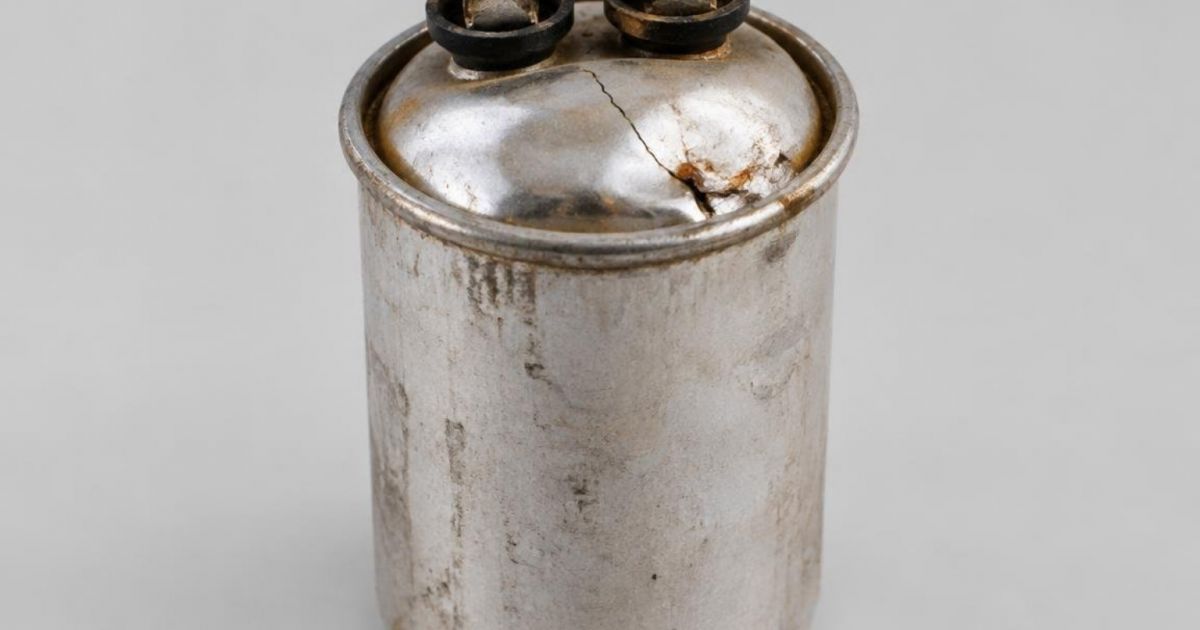
The capacitor is like a large battery that gives the motors the “kick” they need to start. Because of our high temperatures in places like Palatka and Green Cove Springs, capacitors are the most common part to fail.
- The Sign: You might hear a faint humming or buzzing sound coming from the outdoor unit, but the fan isn’t spinning.
- Visual Check: If you look at the top of the capacitor (inside the service panel), it should be flat. If it is “bulged” or leaking oil, it is dead.
The contactor is the switch that closes when the thermostat calls for cooling. If the silver “points” on the contactor become pitted or charred (often called “burned contacts”), electricity can’t flow through to the compressor. You might hear a loud “click” when the AC tries to start, but nothing happens. For more signs that your system is struggling, check out these 4 signs your HVAC unit may need AC service.
Warning: Capacitors store a high-voltage electrical charge even when the power is off. Attempting to replace one yourself without the proper tools and knowledge can result in a dangerous electrical shock.
Frozen Evaporator Coils and Refrigerant Issues
If you see ice on the copper lines leading to your outdoor unit, your system has “frozen up.” This happens for two main reasons:
- Airflow Issues: A dirty filter or a failing blower motor.
- Low Refrigerant: A leak in the system causes the pressure to drop, which in turn causes the temperature of the coil to drop below freezing.
When the coil is a block of ice, air cannot pass through it. Most systems have a safety sensor that will shut the unit down to prevent the liquid refrigerant from flooding back and destroying the compressor (the most expensive part of the system). If you see ice, turn the system to “Off” at the thermostat and turn the “Fan” to “On.” This helps thaw the ice, but you will still need a technician to find the leak or fix the airflow issue.
When to Call a Professional
While we love empowering our neighbors in Putnam and St. Johns counties to handle basic maintenance, some things require a pro. If you’ve gone through the basic checklist and your AC not switching on is still the reality, it’s time to call in the experts.
You should definitely call us if you notice:
- Burning Smells: This indicates a short circuit or a motor winding burning out.
- Repeatedly Tripping Breakers: This is a major electrical red flag.
- Unusual Noises: Screeching, grinding, or heavy clanking.
- The System is 10-15 Years Old: At this age, major components like the compressor are nearing the end of their lifespan.
If you are stuck in the heat and need help right now, you might wonder if you can call emergency maintenance for an AC that isn’t working. The answer is yes, especially in the Florida summer!
What to do if your outdoor AC not switching on persists?
If the indoor fan is blowing but the outdoor unit is silent, the problem is localized to the condenser. This could be a failed fan motor, a dead compressor, or even something as strange as a lizard or frog getting stuck in the contactor (a very common occurrence in Florida!).
Our technicians use specialized meters to check the voltage at every step of the process. We can determine within minutes if the compressor has “grounded out” or if it’s just a $150 capacitor that needs replacing. Getting an expert AC repair diagnostic is the fastest way to get your home back to a livable temperature.
Estimating Common AC Repair Costs
We believe in transparency. While every job is different, here are some general price ranges for common repairs that cause a system not to start:
- Capacitor Replacement: $150 – $350 (Includes part and labor)
- Contactor Replacement: $150 – $300
- Condensate Drain Clearing: $100 – $250
- Thermostat Replacement: $200 – $600 (Depending on the model)
- Blower Motor Replacement: $500 – $1,200
- Refrigerant Leak Repair & Recharge: $400 – $1,500+ (Highly dependent on the amount and type of refrigerant)
- Compressor Replacement: $1,500 – $3,500 (Often, if the unit is old, we recommend a full system replacement instead of this repair)
Conclusion
An AC not switching on is a major stressor, but in many cases, it’s a problem that can be diagnosed and solved quickly. From checking your thermostat batteries to clearing a clogged drain line, these DIY steps can save you the cost of a service call.
However, when the issue involves high-voltage electricity, refrigerant levels, or complex motors, the safest and most cost-effective move is to call a professional. At Southern Air Cooling & Heating, we’ve been serving Palatka and the surrounding areas for over 43 years. As a family-owned business, we pride ourselves on 5-star service and honest advice.
Don’t forget that the best way to prevent your AC from failing is regular maintenance. Our Comfort Club members get priority service and regular tune-ups to catch these issues before they leave you sweating. Plus, we often have specials like $50 off repairs to help keep your home comfortable without breaking the bank.
Whether you’re in St. Augustine, Keystone Heights, or right here in Palatka, we are ready to help. Schedule your professional AC repair today and let us get your cool air back on!
Request Service
Please fill out the form below to request an estimate or schedule service.
"*" indicates required fields