Common Reasons for a Portable AC Blowing Hot Air
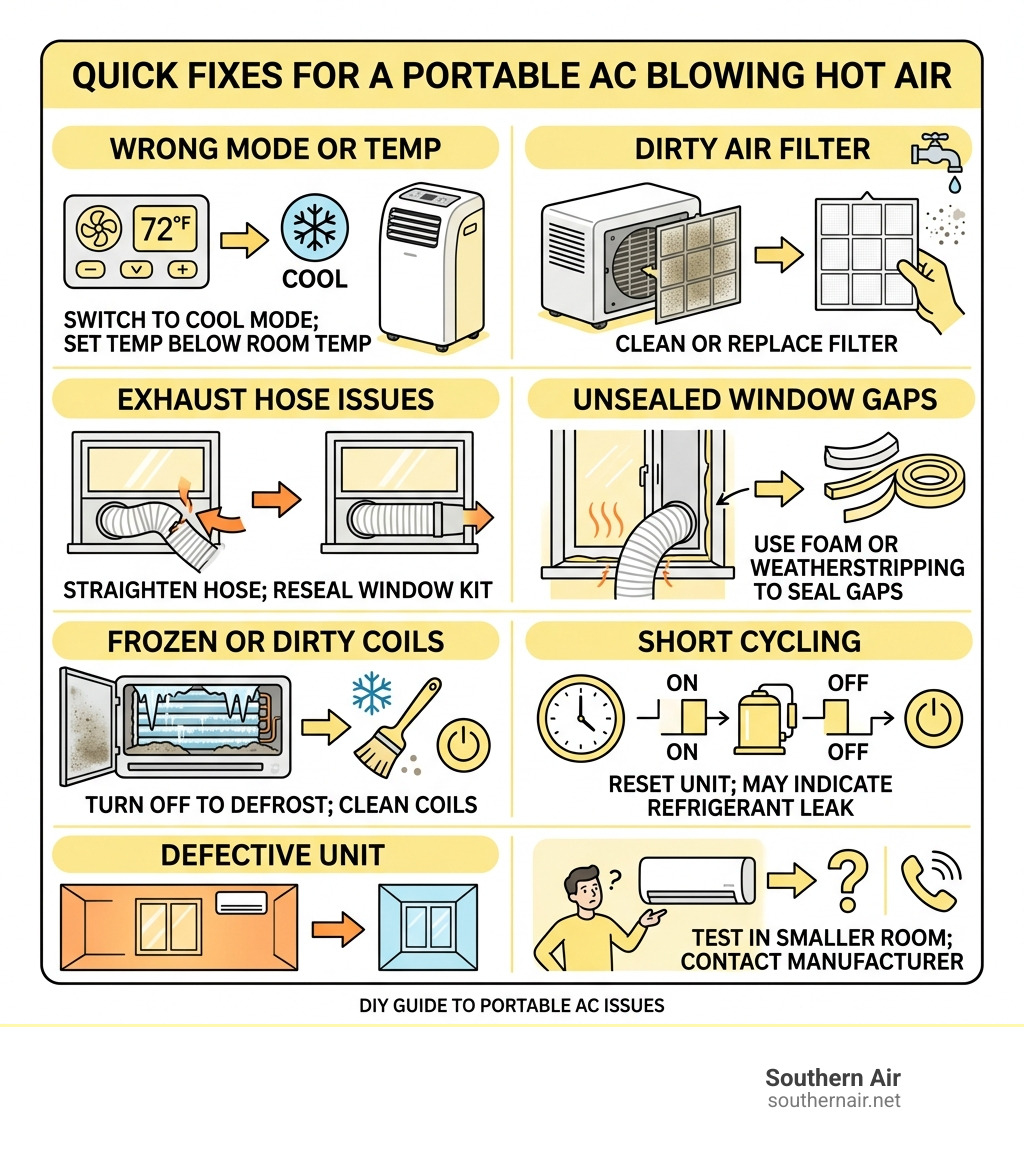
A portable AC blowing hot air is almost always caused by one of these issues:
| Cause | Quick Fix |
|---|---|
| Wrong mode or temperature setting | Switch to Cool mode; set temp below room temp |
| Dirty air filter | Clean or replace the filter |
| Kinked or disconnected exhaust hose | Straighten hose and reseal window kit |
| Unsealed window gaps | Use foam or weatherstripping to seal gaps |
| Frozen or dirty coils | Turn off unit to defrost; clean coils |
| Compressor short cycling | Reset unit; may indicate refrigerant leak |
| Defective unit | Test in a smaller room; contact manufacturer |
It’s the middle of a Florida summer. Your portable AC has been running for hours, but the room feels hotter than when you started. You check the exhaust hose, it’s connected. The settings look right. So what’s going on?
The frustrating truth is that portable AC units are sensitive machines. A small gap in a window seal, a filter clogged with dust, or a compressor that isn’t firing correctly can turn your cooling unit into an expensive fan. These problems are more common than most people realize, and most of them are fixable without a service call.
This guide walks you through every likely cause, from the simplest setting mistakes to more serious internal failures, so you can get your unit cooling again as fast as possible.
I’m Dustin Caison, President and CEO of Southern Air Cooling & Heating, a State Certified Air Conditioning Contractor with over two decades of hands-on HVAC experience, including diagnosing the exact kind of portable AC blowing hot air problems that leave homeowners sweating through the summer. Let’s get your unit back on track.
When your portable air conditioner stops doing its job, it can feel like a personal betrayal. We’ve all been there, standing in front of the vents, hoping for a breeze, only to be met with a gust of lukewarm air. In our experience serving neighbors from Palatka to Fleming Island, we’ve found that a portable AC blowing hot air usually boils down to a few common culprits.
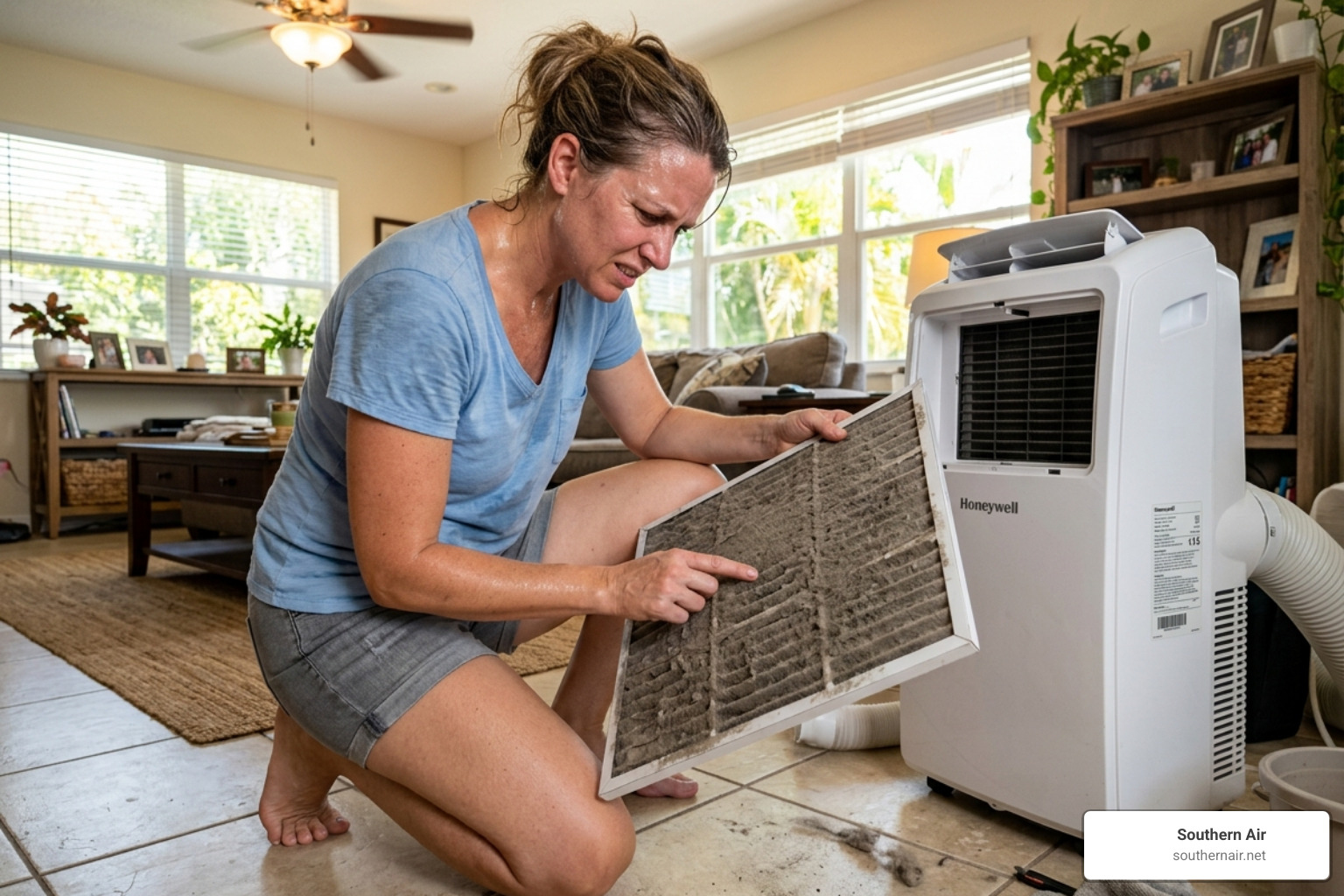
One of the most frequent issues is a dirty air filter. When dust and Florida pollen build up, they choke the airflow, making it impossible for the unit to exchange heat properly. Beyond filters, exhaust leaks are a major “secret” enemy. If the hot air that’s supposed to be leaving your house through the window kit is leaking back into the room, your AC is basically fighting itself.
There are actually 12 reasons your portable AC blows hot air (+ fixes) that range from simple user errors to mechanical failures. If you’re wondering why the air feels more like a hairdryer than a freezer, check out our guide on why is my AC blowing warm air? 7 reasons to see if your symptoms match common household AC struggles.
Checking Your Mode and Thermostat Settings
Before you start taking panels off, let’s check the “brain” of the operation: the settings. It sounds silly, but we’ve seen many cases where a unit was accidentally bumped into “Fan” or “Dehumidifier” mode.
- Cool Mode: Ensure the “Cool” mode is selected. This is usually represented by a snowflake icon. If it’s on “Auto,” the unit might decide the room is “cool enough” and stop the compressor, even if you’re still sweating.
- Temperature Differential: Your thermostat needs to be set at least 5 to 6 degrees below the current room temperature to trigger the compressor. If the room is 75°F and your AC is set to 74°F, the compressor might cycle off too early.
- Fan vs. Auto Fan: In “Fan” mode, the compressor never turns on. You’re just moving room-temperature air around.
If your settings are perfect but you’re still getting nothing but heat, you might need to dig deeper into why is my AC not blowing cold air? to rule out a thermostat calibration issue.
Why Your Portable AC Blowing Hot Air Might Be an Airflow Issue
Airflow is the lifeblood of any cooling system. Portable units draw in warm room air, strip the heat away using refrigerant, and then blow the cooled air back out. If that cycle is interrupted, the unit can’t cool.
A clogged intake or dirty evaporator coils are often the villains here. When the coils are covered in dust, the refrigerant can’t “grab” the heat from the air. This can lead to the unit blowing room-temperature air or, worse, causing the coils to freeze over. If you notice ice on the back of the unit, you’ve got a major airflow restriction. Regular filter maintenance, cleaning them every two weeks during heavy use, is the best way to prevent this.
Troubleshooting the Exhaust and Ventilation System
If the “insides” of the machine are working but the room is still hot, the problem is likely how the heat is leaving, or staying in, your home. Portable ACs are not “ventless.” They must move heat outside.
The exhaust hose is the most critical part of this setup. If it’s kinked, too long, or poorly sealed at the window, you’re in trouble. Portable units create “negative pressure,” meaning they blow air out of the room, which creates a vacuum that pulls air in from elsewhere, often through cracks in doors or window gaps. If your window kit isn’t airtight, you’re literally pulling the 95°F Palatka humidity right back into your bedroom.
Single-Hose vs. Dual-Hose Performance
Not all portable ACs are created equal. Understanding which one you have can explain why it might be struggling.
| Feature | Single-Hose Unit | Dual-Hose Unit |
|---|---|---|
| Air Source | Pulls air from inside the room | Pulls air from outside via second hose |
| Efficiency | Lower (creates negative pressure) | Higher (balanced air exchange) |
| Cooling Speed | Slower in large or leaky rooms | Faster and more consistent |
| Best Use | Small, well-insulated rooms | Larger spaces or high-heat areas |
Single-hose units are notorious for pulling unconditioned air from other rooms or through window gaps. This pressure imbalance makes them significantly less efficient than dual-hose models, which use one hose to bring in outside air to cool the condenser and another to exhaust the heat.
Dealing with Hot Air Infiltration and Room Insulation
Sometimes, the AC is fine, but the room is the problem. If you’re trying to cool an attic office in Green Cove Springs or a sunroom with wall-to-wall glass, the “heat load” might simply be too much for a portable unit.
Portable ACs are often rated for “best-case scenarios.” If your room has poor insulation, high ceilings, or faces the afternoon sun, you might need a unit with a higher BTU capacity than the square footage suggests. For instance, a room that’s 250 sq. ft. might normally need an 8,000 BTU unit, but in a poorly insulated Florida attic, you might need 12,000 BTUs just to keep up. If your unit is running but the temp isn’t dropping, read more on portable air conditioner not blowing cold air but running.
Diagnosing Compressor and Internal Component Failures
If you’ve checked the filters, the hoses, and the settings, and you’re still getting a portable AC blowing hot air, we have to look at the mechanical “heart” of the machine: the compressor.
The compressor is what actually does the cooling. You should hear a distinct “click” followed by a low hum when it kicks on. If you don’t hear that sound, or if the hum only lasts for a few seconds before cutting out, your compressor isn’t working. This is often a sign of 4 signs your HVAC unit may need AC service or, in the case of a portable unit, a sign that it might be time for a replacement.
Understanding Compressor Short Cycling
Short cycling is when the compressor turns on and off rapidly, sometimes every few minutes or even every few seconds. This is usually a safety shutdown mechanism.
Common causes for short cycling include:
- Overheating: If the coils are too dirty or the exhaust is blocked, the unit gets too hot and shuts down to prevent a fire.
- Electrical Glitches: A faulty start capacitor or a bad relay can prevent the compressor from staying on.
- Low Refrigerant: If there’s a leak, the pressure drops, and the safety switch kills the power to the compressor.
If your unit starts cold but turns warm after 10 minutes, short cycling is the likely culprit.
Why Your Portable AC Blowing Hot Air Could Mean a Defective Unit
Sometimes, despite your best efforts, the unit is just a “lemon.” Portable ACs are hermetically sealed, meaning the refrigerant is locked inside at the factory. Unlike a central AC system, you can’t easily “recharge” a portable unit. If it has a refrigerant leak, you’ll often see oily residue near the base or on the coils.
Other signs of a defective unit include:
- Faulty Thermistor: This is the sensor that tells the AC how hot the room is. If it’s broken, the AC thinks the room is already 60°F and won’t turn on the cooling.
- Control Board Failure: If the buttons don’t work or the unit displays weird error codes, such as “CH” or “FL” on LG models, the internal computer might be fried.
If you suspect a major defect, be careful. There are the risks of putting off AC repair services, including electrical shorts or further damage to your home’s outlets.
Step-by-Step Maintenance to Restore Cooling
Ready to get your hands dirty? Most cooling issues can be solved with a thorough cleaning.
How to Clean and Reset Your Unit
- Power Down: Unplug the unit. Safety first!
- Clean the Filters: Remove all washable filters. Use lukewarm soapy water, rinse them, and let them dry completely before putting them back.
- Vacuum the Coils: Use a vacuum with a soft brush attachment to gently remove dust from the evaporator and condenser coils, the metal fins behind the filters.
- Check the Drainage: Even “self-evaporating” units can get backed up. Drain the manual condensate tank to ensure there’s no standing water triggering a safety shutoff.
- The 10-Minute Reset: This is the “have you tried turning it off and on again” of the HVAC world. Unplug the unit for at least 10 minutes. This allows the internal sensors and the control board to reset and the refrigerant pressures to equalize.
For more detailed help on units that won’t even power up, check out our troubleshooting tips for AC systems that wont turn on.
Preventing Future Cooling Failures
Maintenance shouldn’t just happen when the unit breaks. To keep your portable AC blowing cold all summer in St. Augustine or Interlachen, follow this schedule:
- Weekly: Check and clean filters if you have pets or a dusty environment.
- Monthly: Inspect the exhaust hose for cracks or leaks.
- End of Season: Run the unit in “Fan Only” mode for 12 hours to dry out the internal coils before storing it. This prevents mold and “sock smell.”
- Storage: Always store the unit upright. If you tilt it or lay it on its side, the oil from the compressor can flow into the cooling lines. If you must move it on its side, let it sit upright for at least 24 hours before turning it on.
If your unit is more than 5 years old and starts acting up, you might be facing the classic dilemma: should I repair or replace my AC unit?
Frequently Asked Questions about Portable AC Units
Why is my exhaust air cold instead of hot?
This is a major red flag! The exhaust air should be very hot because it’s carrying all the heat from your room. If the exhaust air is cold or room temperature, it means the heat exchange process isn’t happening. This usually means the compressor isn’t running or the unit is low on refrigerant.
Why is there no water in the condensate tray?
In very dry climates, this is normal. However, in Florida’s humidity, your AC should be pulling a lot of water out of the air. If the tray is bone dry after hours of use, the unit isn’t dehumidifying, which usually means it isn’t cooling effectively either.
How do I reset my portable AC unit to fix glitches?
Most units don’t have a dedicated “Reset” button. The best way to reset is to unplug it from the wall, wait 10-15 minutes, and plug it back in. This clears the internal memory and allows the compressor to start fresh.
When to Call a Professional for Repair
We love a good DIY project, but portable ACs have their limits. Because they are sealed systems, most local repair shops won’t work on them. It’s often cheaper to buy a new one than to pay for the labor of cutting into the lines to fix a leak.
However, if your portable unit is part of a larger cooling strategy for your home and you’re finding that none of your rooms are staying cool, it might be time for a professional eye. At Southern Air Cooling & Heating, we’ve spent 43+ years helping families in Palatka, Hawthorne, and Keystone Heights stay comfortable.
If you’re tired of a portable AC blowing hot air and want to discuss a more permanent and reliable cooling solution like a mini-split or a central AC tune-up, we’re here to help. We offer 5-star service and specials like $50 off repairs for our neighbors.
Don’t spend another night sweating. Check out our AC repair services or contact us today!
Request Service
Please fill out the form below to request an estimate or schedule service.
"*" indicates required fields