How Ductless Technology Works
A ductless mini split HVAC system is a heating and cooling solution that works without any ductwork, connecting a small outdoor compressor unit to one or more indoor air handlers through a narrow conduit in the wall.
Here’s a quick breakdown of what makes them different:
- No ducts required – only a small 3-inch hole in the wall is needed for installation
- Zoned comfort – each indoor unit controls its own area independently
- Heating and cooling in one – most mini splits function as heat pumps, working year-round
- High efficiency – ductless systems can achieve SEER2 ratings up to 35, compared to 25 for typical ducted systems
- Whisper-quiet – indoor units operate as low as 20 decibels
In short: if your home doesn’t have existing ductwork, or you want precise temperature control in specific rooms, a ductless mini split is worth a serious look.
These systems have become one of the fastest-growing HVAC solutions heading into 2026, and for good reason. Duct losses alone can account for more than 30% of a home’s energy consumption, especially when ducts run through unconditioned spaces like attics. Ductless systems eliminate that waste entirely.
I’m Dustin Caison, President and CEO of Southern Air Cooling & Heating, a State Certified Air Conditioning Contractor with over two decades of hands-on experience installing and servicing ductless mini split HVAC systems across North Florida. In the sections below, I’ll walk you through everything you need to know, from how these systems work to whether one is the right fit for your home.
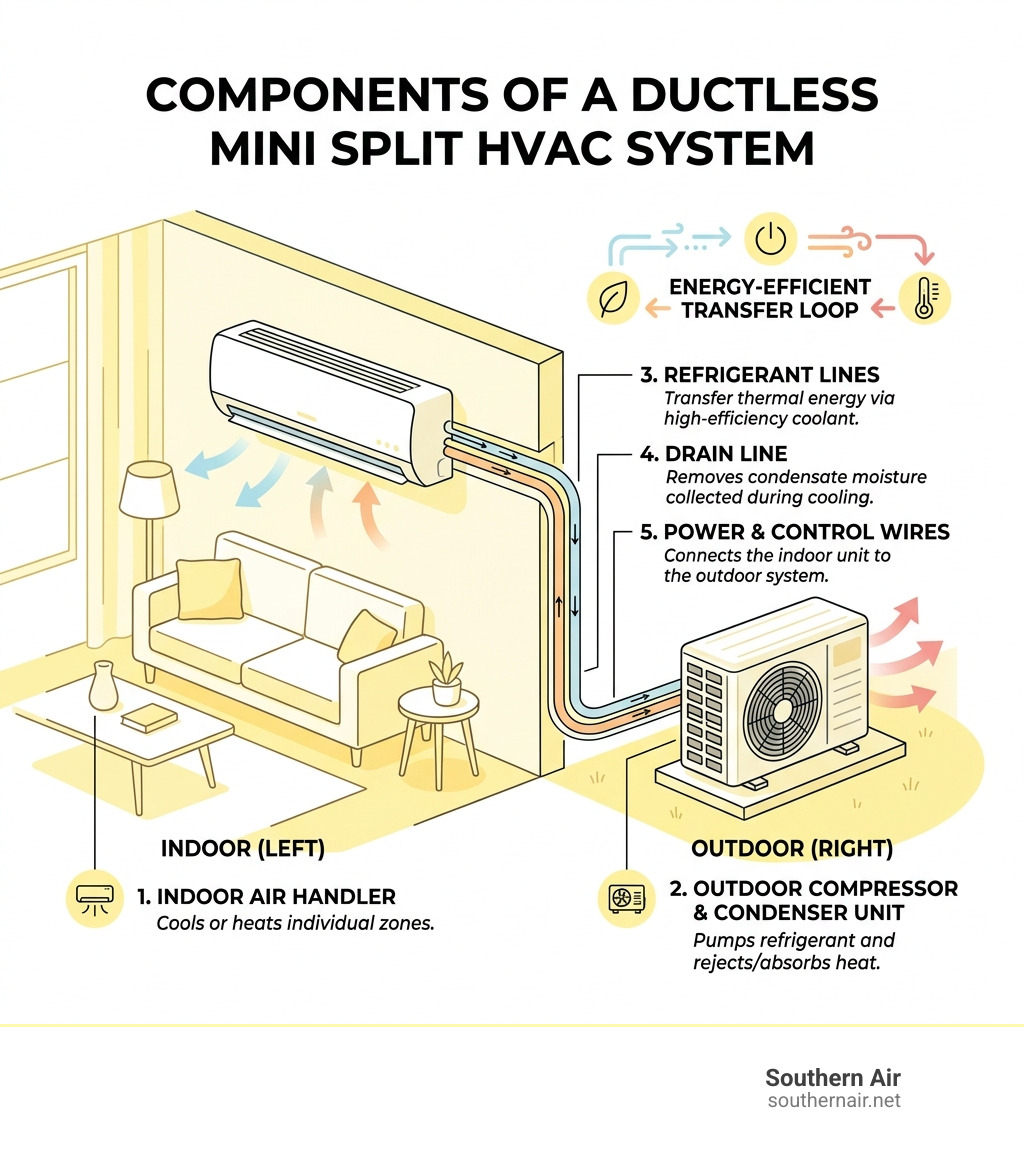
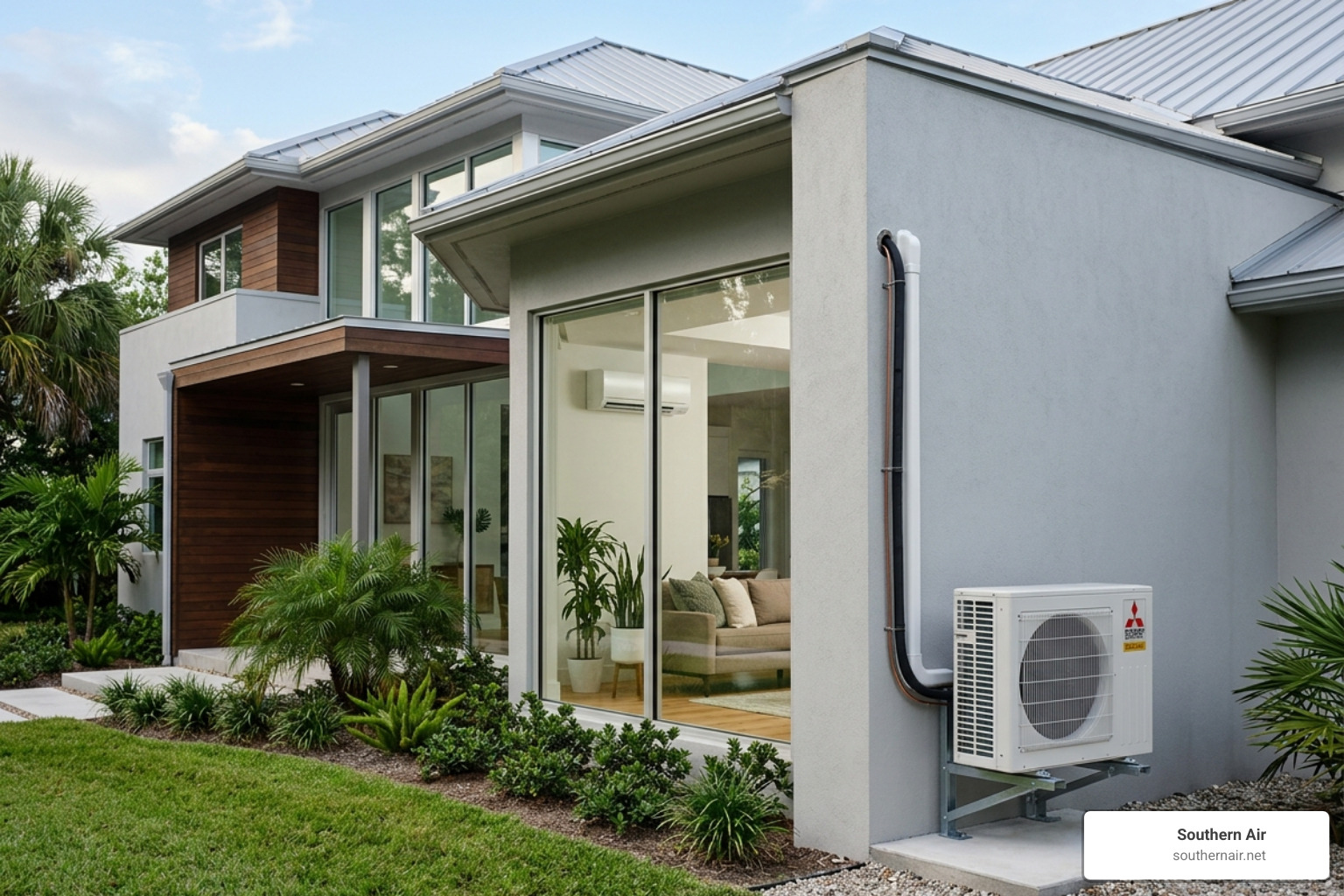
To understand why a ductless mini split HVAC is so effective, we have to look at what’s happening behind the scenes. Unlike a central furnace or AC that pushes air through a maze of metal ducts, a mini split delivers comfort directly to the room.
The system consists of two primary players: an outdoor compressor (the “muscle”) and one or more indoor air-handling units (the “delivery”). These two are linked by a “conduit” which houses the power cable, refrigerant tubing, suction tubing, and a condensate drain. This setup allows for incredible flexibility, as the outdoor unit can be located up to 50 feet away from the indoor evaporator.
The Refrigerant Cycle and Inverter Technology
At its heart, a mini split is a heat pump. It doesn’t “create” heat or cold; it moves it. In the summer, the indoor unit absorbs heat from your room and sends it outside. In the winter, the process reverses, even in chilly temperatures, extracting heat from the outdoor air to warm your home.
One of the coolest features of modern systems is inverter technology. Traditional AC units are either “on” or “off,” which leads to those annoying temperature swings and high energy spikes. Inverters work like a dimmer switch, allowing the compressor to speed up or slow down to maintain a steady temperature. This is a big part of how do ductless mini splits work so efficiently. According to the Department of Energy, this direct heat transfer avoids the massive energy losses associated with central ductwork.
The Advantages of a ductless mini split HVAC System
Why are so many of our neighbors in Palatka and Fleming Island making the switch? It usually comes down to three things: control, quiet, and cash savings.
First, let’s talk about “zoning.” With a ductless mini split HVAC, you aren’t forced to cool the guest room you haven’t used in three weeks just to keep your bedroom comfortable. Each indoor unit has its own thermostat. This “spot conditioning” can lead to energy savings of up to 40% compared to conventional systems.
Then there’s the noise or lack thereof. Traditional window units sound like a jet engine taking off in your living room. A high-quality mini split indoor unit operates as low as 20dB. For context, that is literally whisper-quiet. Even the outdoor units are impressively hushed, with some operating at 46 decibels, which is about the volume of a normal conversation.
Other key benefits of ductless mini split systems include:
- Improved Air Quality: Because there are no ducts to collect dust, pollen, or mold, the air stays cleaner. Most units feature multi-stage filtration to trap allergens.
- Flexible Placement: Indoor units can be mounted on walls, suspended from ceilings, or even tucked into floor-standing models.
- Eco-Friendly: Many systems are ENERGY STAR certified, reducing your carbon footprint by avoiding the 30% energy loss typical of leaky ducts.
Understanding ductless mini split HVAC Efficiency Ratings
When you’re shopping for a system, you’ll see a lot of acronyms. Here’s the “cheat sheet” to help you understand what you’re paying for:
- SEER2 (Seasonal Energy Efficiency Ratio): This measures cooling efficiency. The higher the number, the less electricity it uses. While ducted units usually max out around 25 SEER2, ductless systems can soar up to 35 SEER2.
- HSPF2 (Heating Seasonal Performance Factor): This measures heating efficiency. Top-tier mini splits can reach ratings of 11.9 to 18 HSPF2.
- EER (Energy Efficiency Ratio): This is a snapshot of efficiency at a specific outdoor temperature (usually 95°F).
As EnergySage notes, investing in a higher SEER2 unit might cost more upfront, but the long-term utility savings in a climate like Florida’s often make it the smarter financial move.
Comparing Ductless to Traditional HVAC
If you’re torn between a central system and a mini split, it helps to see the data side-by-side.
| Feature | Ductless Mini Split | Central AC (Ducted) | Window Units |
|---|---|---|---|
| Efficiency (SEER2) | Up to 35 | Up to 25 | Very Low |
| Energy Loss | Near 0% | 30%+ (via ducts) | High (leaks around window) |
| Noise Level | Whisper Quiet (20-46dB) | Moderate (Duct pinging) | Loud/Vibrating |
| Installation | Easy (3″ hole) | Complex/Invasive | Easy but insecure |
| Zoning | Standard | Requires expensive dampers | Room-by-room |
| Lifespan | 15–20 Years | 10–15 Years | 5–8 Years |
As the Lennox buyer’s guide explains, central AC is great for whole-home cooling if you already have ducts. But if you’re retrofitting an older home or adding a room, the cost of installing new ductwork can be astronomical compared to the streamlined setup of a ductless system.
Is a ductless mini split HVAC Right for Your Home?
We often recommend ductless systems for specific “problem areas” in Florida homes. For example, is a ductless mini split a good option for a sunroom? Absolutely. Sunrooms are notorious for being too hot for central AC to handle. A mini split provides the dedicated “oomph” needed to keep that glass-walled room frosty in July.
Other perfect scenarios include:
- Garage Conversions: If you’re turning your garage into a workshop or gym, a mini split is the most cost-effective way to add climate control.
- Older Homes: Many historic homes in areas like St. Augustine or Palatka use radiant heat or space heaters and lack the space for bulky ductwork.
- New Additions: Why upsize your entire central HVAC system for one new bedroom? A single-zone mini split is a much simpler solution.
- Home Offices: If you work from home, you can keep your office cool during the day without wasting money cooling the rest of the house.
Installation and Cost Considerations
One of the biggest selling points for a ductless mini split HVAC is that it doesn’t require a major renovation. We don’t have to tear out ceilings or build soffits. We simply mount the indoor unit and drill a small three-inch hole to connect it to the outside.
However, “simple” doesn’t mean “DIY.” Professional installation is critical. We have to perform a “Manual J” calculation to ensure the unit is sized correctly. If a unit is too large, it will “short cycle,” turning on and off constantly, which kills efficiency and fails to remove humidity.
The Bottom Line: What Does It Cost?
So, how much does it cost to install a mini split AC system? On average, a quality single-zone ductless system ranges between $3,000 and $6,000 including installation. This is roughly the same as a central AC replacement, but you get much higher efficiency and a longer lifespan.
For multi-zone systems (where one outdoor unit powers several rooms), the price increases based on the number of indoor units and the complexity of the refrigerant line runs. While the upfront investment is significant, the future of home heating and cooling is moving toward these systems because the long-term ROI through lower power bills is so strong. Plus, there are often federal tax credits (up to $2,000) and local utility rebates available for ENERGY STAR models.
Frequently Asked Questions about Ductless Systems
Can I install a mini split as a DIY project?
While you might see “DIY kits” online, we strongly advise against it. Bryant’s guide to ductless HVAC points out that professional installation is required to keep your manufacturer’s warranty intact. Handling refrigerant requires a specialized license, and if the lines aren’t vacuumed and sealed perfectly, the system will leak and fail within a few years. Saving a few bucks on labor isn’t worth voiding a 10-year warranty.
What maintenance is required for ductless units?
Mini splits are low-maintenance, but they aren’t “no-maintenance.”
- Filter Cleaning: You should wash the mesh filters in your indoor units every 1–3 months. It’s easy, just pop the front panel, rinse them in the sink, and let them dry.
- Clear the Outdoor Unit: Keep leaves, dirt, and weeds away from the outdoor compressor to ensure proper airflow.
- Annual Service: Just like a car, your system needs a professional tune-up once a year. We check refrigerant levels, clean the coils, and ensure the condensate drain isn’t clogged. You can find more details on our ductless mini split service page.
How many indoor units can connect to one outdoor unit?
This is the beauty of a multi-zone system. Depending on the brand and model, a single outdoor compressor can support up to 8 indoor units. This allows you to create a whole-home solution where every family member has individual comfort control over their own space. Just remember: in a multi-zone setup, all units generally need to be in the same mode (either all cooling or all heating) at the same time.
Conclusion
At Southern Air Cooling & Heating, we’ve spent over 43 years helping our neighbors in Palatka, Green Cove Springs, and throughout North Florida stay comfortable. We’ve seen HVAC technology evolve, but few things have changed the game for homeowners as much as the ductless mini split HVAC.
Whether you’re looking to tame a hot sunroom, finish a garage, or finally get efficient cooling into an older home, our family-owned team is here to help. We offer 5-star service, priority Comfort Club maintenance plans, and a deep understanding of the unique climate challenges we face here in Florida.
Ready to see if a ductless system is right for you? Schedule your ductless mini split installation today and let us help you find the perfect, whisper-quiet solution for your home.
Request Service
Please fill out the form below to request an estimate or schedule service.
"*" indicates required fields